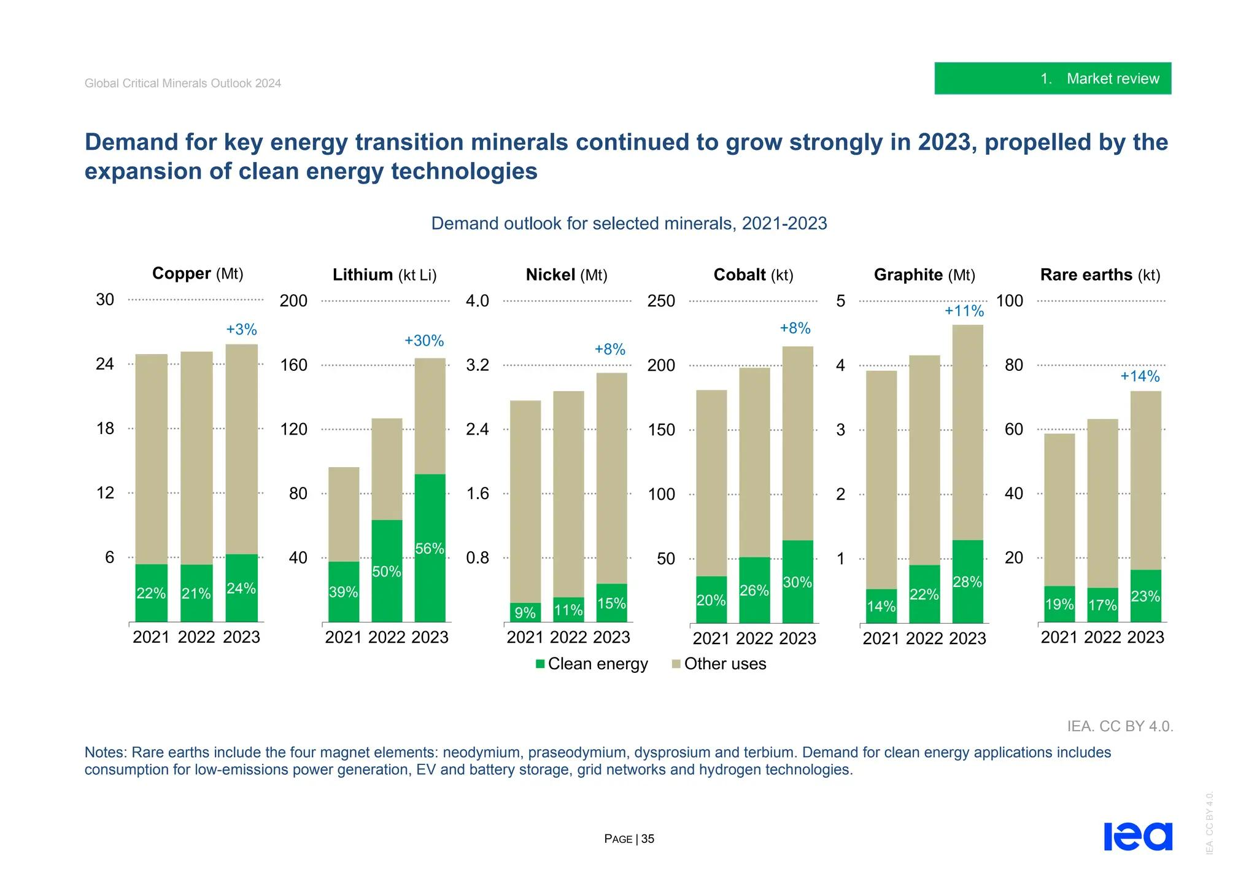
This chart illustrates the strong growth in global demand for key energy transition minerals between 2021 and 2023, driven primarily by the rapid expansion of clean energy technologies such as electric vehicles, battery storage, renewable power generation, grid infrastructure, and hydrogen systems. Lithium experienced the fastest growth, increasing by approximately 30% in 2023, followed by rare earth elements (+14%), graphite (+11%), nickel and cobalt (both +8%), and copper (+3%). The green sections of each bar represent demand from clean energy applications, while the beige sections represent traditional uses. The chart also shows that clean energy is becoming an increasingly important driver of mineral consumption, accounting for 56% of lithium demand, 30% of cobalt, 28% of graphite, 24% of copper, 23% of rare earth elements, and 15% of nickel in 2023. These trends highlight the accelerating global transition toward low-carbon technologies and underscore the growing strategic importance of securing reliable supplies of critical minerals to support the energy transition.
Why now is the right time to invest in critical minerals?
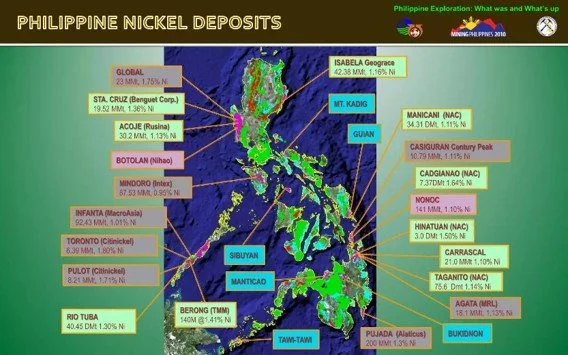
The Philippines hosts significant world-class deposits of nickel, copper, cobalt, chromite, and gold, making it an important source of materials used in electric vehicle batteries, power grids, renewable energy systems, electronics, and stainless steel production. Its location in the center of the Indo-Pacific, near major manufacturing hubs such as Japan, South Korea, Taiwan, China, and the rest of ASEAN, provides efficient access to regional processing facilities and global shipping routes, positioning the country as a strategically valuable partner in diversifying and securing critical mineral supply chains.
The Philippines is increasingly viewed by allied economies as a key partner for diversifying critical mineral supply chains and reducing dependence on concentrated sources.
Strategic Importance of the Philippines
This chart projects that global demand for critical minerals used in clean energy technologies will increase by at least fourfold by 2040 to achieve international climate goals, with even greater demand under a net-zero emissions pathway. The largest share of future mineral demand is expected to come from electric vehicles and battery storage, followed by electricity networks, solar photovoltaic systems, wind power, and other low-carbon energy technologies. Among individual minerals, lithium is projected to experience the most significant growth, with demand increasing approximately 42 times compared to 2020 levels. Graphite, cobalt, and nickel are also expected to see substantial increases of about 25, 21, and 19 times, respectively, while demand for rare earth elements is projected to rise sevenfold. These projections highlight the critical role that mineral supply will play in supporting the global energy transition and emphasize the need for increased exploration, responsible mining, and secure supply chains to meet future energy demand.